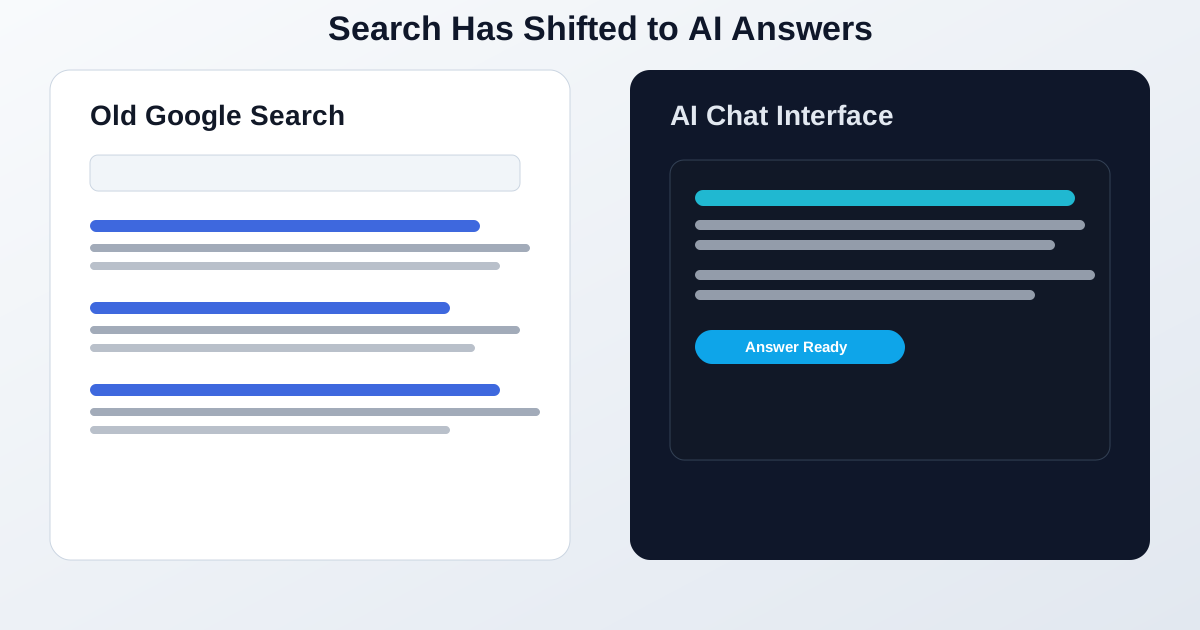
📌 Quick Summary: Google still exists — but it no longer controls how people find information. AI tools like ChatGPT, Perplexity, and Google's own AI Overviews are answering questions directly, skipping your website entirely. If you're still only doing traditional SEO, you're already invisible to millions of searchers. This guide shows you what's happening and exactly what to do about it.
Need implementation support? See our AI automation services to turn this into a practical rollout plan.
Table of Contents
- The Death of Traditional Search — What's Really Happening
- What is Generative Engine Optimization (GEO)?
- GEO vs SEO: Key Differences Explained
- The Numbers Don't Lie: AI Search Statistics 2026
- Why Your Website is Losing Traffic Right Now
- How AI Decides What Content to Cite
- 7 Proven GEO Strategies to Rank in AI Search
- Traditional SEO Still Matters — Here's Why
- GEO + SEO Together: The Winning Formula for 2026
- Action Plan: What to Do This Week
- Frequently Asked Questions
1. The Death of Traditional Search — What's Really Happening
Keywords targeted: AI replacing Google search, future of Google, is Google dying, AI search engines 2026
Let's be direct. Google is not dead. But the way people use it — and find information online — has changed forever.
For nearly 25 years, the internet worked one way: someone had a question, they typed it into Google, Google returned a list of blue links, and people clicked. Your website's entire survival depended on appearing in that list. That era is over.
In 2026, when someone asks "What's the best CRM for a small business?" or "How do I fix a leaking pipe?" or "Which laptop should I buy?" — they don't scroll through ten links anymore. They ask ChatGPT, Perplexity AI, Google AI Overviews, Microsoft Copilot, or Google Gemini. These AI tools synthesize the entire internet and deliver one complete answer — instantly.
No blue links. No clicking. No visiting your website.
This is the single biggest disruption in the history of digital marketing. And the brands and creators who understand it first will dominate the next decade. Those who ignore it will slowly disappear from the internet — even if they rank #1 on Google.
2. What is Generative Engine Optimization (GEO)?
Keywords targeted: what is GEO, generative engine optimization definition, GEO meaning, AI SEO, GEO strategy
Generative Engine Optimization (GEO) is the practice of optimizing your content so that AI-powered search engines — like ChatGPT, Google AI Overviews, Perplexity, Claude, and Gemini — cite, reference, and recommend your brand in their generated answers.
Think of it this way:
- Traditional SEO = Getting your page to rank #1 on Google's results page
- GEO = Getting your brand mentioned inside the AI's answer, even before a results page exists
When someone asks an AI "What are the best digital marketing agencies?" and your brand's name appears in that answer — that's GEO working for you.
GEO is not about keyword stuffing. It is not about tricking algorithms. It is about becoming the most trustworthy, structured, authoritative, and citable source in your niche — so that AI systems naturally pull your content when constructing answers.
How Does GEO Work?
AI engines like ChatGPT and Perplexity are trained on vast amounts of web data. When generating an answer, they evaluate content based on:
- Authority — Is this source credible and well-established?
- Structure — Is the content clearly organized and easy to extract?
- Accuracy — Does the information align with other trusted sources?
- Directness — Does the content answer questions clearly and immediately?
- Freshness — Is the information current and up-to-date?
If your content scores high on all five, AI will cite you. If not, your competitor gets the mention — and the visibility.
3. GEO vs SEO: Key Differences Explained
Keywords targeted: GEO vs SEO, difference between GEO and SEO, SEO vs AI search, generative engine optimization vs search engine optimization
Understanding the difference between GEO and SEO is no longer optional — it's survival knowledge for every website owner, marketer, and business in 2026.
| Factor | Traditional SEO | Generative Engine Optimization (GEO) |
|---|---|---|
| Goal | Rank on Google's results page | Get cited in AI-generated answers |
| Primary Target | Google, Bing | ChatGPT, Perplexity, Google AI Overviews, Gemini |
| Success Metric | Rankings, clicks, organic traffic | AI mentions, brand citations, share of voice in AI |
| Content Strategy | Keyword density, backlinks | Authority, structure, direct answers, entity clarity |
| Key Tactics | Meta tags, link building, keyword research | Schema markup, FAQ content, clear expertise signals |
| User Behavior | User clicks a link and visits your page | AI answers the user directly — may or may not link back |
| Timeline | Takes months to rank | Authority builds over time but citations can happen faster |
| Zero-Click Impact | Affected by zero-click results | Designed for zero-click environments |
The critical insight here is this: GEO and SEO are not competitors — they are partners. You need both. SEO builds your visibility in traditional results. GEO builds your visibility in AI answers. Together, they cover the entire modern search landscape.
4. The Numbers Don't Lie: AI Search Statistics 2026
Keywords targeted: AI search statistics 2026, Google traffic decline, AI search growth, ChatGPT search volume, zero-click search statistics
The data is in. The shift is real. Here are the numbers every website owner needs to see:
- Google AI Overviews now appear in 57% of all search engine results pages — up from just 25% in August 2024. That is more than double in under 18 months.
- When an AI Overview appears, only 8% of users click on organic results below it. Without an AI Overview, that click rate is 15%. Still low — but almost double.
- The click-through rate for the #1 Google ranking dropped from 7.3% to 2.6% in just twelve months for keywords that now trigger AI Overviews.
- Gartner predicts a 25% reduction in traditional search volume by end of 2026, driven directly by AI chatbots and virtual search agents.
- Nearly 9 in 10 queries triggering AI Overviews are informational — the exact type of content most businesses invest heavily in creating.
- Over 100 million people use ChatGPT for search-related queries every month.
What do these numbers mean? The content you've been creating to drive organic traffic — the how-to guides, explainers, listicles, and FAQ pages — is being consumed by AI and delivered to users without a single click to your website.
You are feeding the machine. But the machine is not sending visitors back.
This is not the future. This is today.
5. Why Your Website is Losing Traffic Right Now
Keywords targeted: website traffic declining, organic traffic drop 2026, why my website lost traffic, AI cannibalization SEO, zero-click search impact
If your website's organic traffic has declined in the past 12 months and you can't explain why, AI search is almost certainly the reason.
Here's the mechanism:
Step 1: A user searches for something your blog or website answers perfectly.
Step 2: Google's AI Overview reads your content, summarizes it, and places the answer at the very top of the page.
Step 3: The user reads the answer, gets what they need, and leaves — without ever clicking your link.
Step 4: Your Google Analytics shows the search impression but zero clicks. Your traffic drops. Your bounce rate rises.
This is called zero-click cannibalization — and it is happening right now, across every industry, in every niche.
The websites hit hardest are those with purely informational content: recipe blogs, how-to guides, health information sites, news summaries, product review sites, and educational content. If your website answers questions, AI search is eating your traffic.
The solution is not to stop creating content. The solution is to create content that positions your brand as the source AI cites — and to ensure that when AI mentions you, it drives brand recognition, authority, and high-intent traffic even without a direct click.
6. How AI Decides What Content to Cite
Keywords targeted: how AI cites content, how to rank in AI search, AI content ranking factors, get cited by ChatGPT, appear in Google AI Overviews, Perplexity ranking factors
Understanding what makes AI choose one source over another is the foundation of every successful GEO strategy. Here are the core factors AI systems evaluate:
1. Entity Clarity
AI engines are built around entities — people, places, brands, concepts. Your content needs to clearly establish who you are, what you do, and why you are an authority. Vague, generic content gets ignored. Specific, well-defined content gets cited.
2. Structured, Direct Answers
AI wants to pull clean, concise answers — not wade through paragraphs of background. Content that leads with a clear definition or answer, followed by supporting context, is far more likely to be cited than content that buries the key point halfway down the page.
3. E-E-A-T Signals (Experience, Expertise, Authoritativeness, Trustworthiness)
Google's own E-E-A-T guidelines, which already influence traditional SEO, are even more critical for GEO. AI systems favor content from identifiable experts with verifiable credentials and a consistent publishing track record.
4. Schema Markup and Structured Data
Technical schema markup — including FAQ schema, HowTo schema, Article schema, and Organization schema — helps AI systems parse and extract your content far more effectively. This is one of the highest-leverage technical investments you can make in 2026.
5. Cross-Platform Brand Presence
AI engines don't just look at your website. They synthesize information from Reddit, Quora, third-party review sites, news articles, LinkedIn, Wikipedia, and more. Your brand's authority is the sum of its entire digital footprint — not just its homepage.
6. Citations and External Validation
Content that cites credible external sources — research papers, government data, industry reports — signals to AI that the content is well-researched and reliable. Interestingly, content with citations and statistics gets cited by AI at significantly higher rates than unsupported claims.
7. Freshness and Accuracy
Outdated information is an AI liability. AI systems are trained to avoid recommending content that conflicts with current consensus. Regular content audits and updates are now essential — not just for users, but for AI visibility.
7. Seven Proven GEO Strategies to Rank in AI Search
Keywords targeted: GEO strategies, how to optimize for AI search, generative engine optimization tips, rank in ChatGPT, appear in Perplexity, AI SEO strategies 2026, optimize for Google AI Overviews
Here are seven concrete strategies that are driving results right now:
Strategy 1: Lead Every Page With a Direct Answer
Start your articles with a 2-3 sentence summary that directly answers the primary question. This is called a "topic lede" — and it dramatically increases the chance that AI will extract and cite your content. Think of it as writing a Wikipedia-style opening for every piece of content you create.
Strategy 2: Build Comprehensive FAQ Sections with Schema
Add detailed FAQ sections to every major page on your website and implement FAQ schema markup in your HTML. AI engines heavily favor structured Q&A content because it is easy to extract and match to user queries. Target long-tail conversational questions — the kind people actually ask AI tools.
Strategy 3: Establish Clear Entity Identity
Create a thorough "About" page that clearly defines your brand's expertise, credentials, history, and mission. Ensure your Google Business Profile, LinkedIn, Wikipedia (if applicable), and major directory listings are all consistent and up-to-date. The clearer your brand's identity across the web, the more confidently AI will reference you.
Strategy 4: Publish Original Data and Research
AI systems disproportionately cite content that contains original data, proprietary research, and unique statistics. Even simple original surveys, industry analyses, or case studies give AI a reason to quote you specifically — rather than a generic competitor.
Strategy 5: Dominate Third-Party Platforms
Your website is one signal among many. Actively build presence on platforms AI frequently references: contribute to Reddit threads, answer questions on Quora, earn mentions in industry publications, generate authentic reviews on G2 or Trustpilot, and maintain an active LinkedIn presence. Each mention strengthens the AI's confidence in your brand.
Strategy 6: Implement Comprehensive Schema Markup
Beyond FAQ schema, implement Article schema, HowTo schema, Person schema for authors, Organization schema, Product schema, and Breadcrumb schema across your entire site. This technical investment is one of the clearest signals you can give to both traditional search engines and AI systems about what your content contains and who it comes from.
Strategy 7: Optimize for Conversational, Long-Tail Queries
AI search is conversational by nature. Instead of targeting short keywords like "best CRM," target natural language questions like "What is the best CRM for a freelancer with under 100 clients?" Create dedicated content that matches how real people ask questions in AI interfaces — and you will capture traffic that keyword-focused competitors miss entirely.
8. Traditional SEO Still Matters — Here's Why
Keywords targeted: is SEO dead, does SEO still work in 2026, traditional SEO 2026, Google ranking still important, SEO vs GEO which is better
Before you conclude that traditional SEO is obsolete, pause. It is not.
For all the disruption AI search is causing, billions of searches still happen on Google every single day. Traditional search results still drive massive traffic to websites across every category. SEO rankings still translate directly to revenue, leads, and growth for millions of businesses worldwide.
Here's the honest picture: SEO is not dead. It is evolving.
Traditional SEO best practices — site speed, mobile optimization, clean architecture, high-quality content, backlinks, meta optimization — still form the foundation of everything. In fact, strong SEO directly supports GEO. The same signals that help you rank in Google (authority, clarity, technical soundness, E-E-A-T) also help AI engines cite you.
The difference in 2026 is that SEO alone is no longer sufficient. A #1 Google ranking with no AI visibility means you're winning yesterday's game while losing tomorrow's. You need both layers working together.
Think of it as a two-floor building. SEO is the foundation and ground floor — solid, essential, and weight-bearing. GEO is the second floor — the new space where the next generation of discovery happens. You cannot build the second floor without the first. But a single-story building in 2026 is leaving enormous opportunity on the table.
9. GEO + SEO Together: The Winning Formula for 2026
Keywords targeted: GEO and SEO strategy, integrate GEO with SEO, AI visibility strategy, digital marketing strategy 2026, search visibility 2026
The brands winning in 2026 are not choosing between GEO and SEO. They are building unified content ecosystems that serve both human searchers and AI systems simultaneously.
Here is what that integrated strategy looks like in practice:
Content Layer: Every piece of content is written to answer a specific user question clearly and directly (GEO), while also being optimized with targeted keywords, proper heading structure, and internal links (SEO).
Technical Layer: Sites are fast, mobile-optimized, and crawlable (SEO), with comprehensive schema markup that makes content machine-readable for AI (GEO).
Authority Layer: Backlink building and domain authority development (SEO) is paired with brand mention campaigns, PR outreach, and third-party platform presence (GEO).
Measurement Layer: Teams track traditional SEO metrics — rankings, organic traffic, CTR (SEO) — alongside AI visibility metrics like brand mentions in ChatGPT responses, share of voice in Perplexity, and citation frequency in Google AI Overviews (GEO).
The companies implementing this unified approach today are building compounding advantages that will be extremely difficult for late movers to overcome. The earlier you start, the wider your lead becomes.
10. Action Plan: What to Do This Week
Keywords targeted: GEO action plan, how to start GEO, AI SEO checklist, optimize website for AI 2026, AI search optimization steps
You don't need to overhaul your entire website overnight. Start here:
Day 1–2: Audit Your Most Visited Pages
Open Google Search Console and identify your top 10 traffic-driving pages. For each one, ask: Does this page open with a direct, clear answer? Does it have an FAQ section? Is there schema markup? These are your first GEO quick wins.
Day 3–4: Add FAQ Sections + Schema
For each top page, add 5-8 frequently asked questions relevant to the topic. Use FAQ schema markup so AI systems can parse the questions and answers directly. This alone can begin increasing AI visibility within weeks.
Day 5–6: Strengthen Your Entity Presence
Update your About page, Google Business Profile, and LinkedIn company page to be thorough, consistent, and credible. List your team's credentials, your publication history, and specific areas of expertise.
Day 7: Set Up AI Visibility Tracking
Start monitoring where and how your brand appears in AI-generated answers. Manually query ChatGPT, Perplexity, and Google AI Overviews for your top target keywords and note whether your brand is mentioned. Use this as your baseline — and measure it monthly.
From there, build a content calendar that produces at least two GEO-optimized pieces per month, targets conversational long-tail queries, includes original data or insights, and gets promoted across third-party platforms for maximum citation potential.
11. Frequently Asked Questions
Keywords targeted: GEO FAQ, generative engine optimization questions, AI search FAQ, SEO 2026 questions
Q: Is Google really dying because of AI?
Google is not dying, but its dominance over how people find information is declining. AI tools are now the first stop for millions of searchers, and Google itself is integrating AI into its search results through AI Overviews — fundamentally changing how traditional search works.
Q: What is GEO in simple terms?
GEO (Generative Engine Optimization) means optimizing your website and content so that AI tools like ChatGPT, Perplexity, and Google AI Overviews mention and recommend your brand when answering user questions — even if the user never visits your website directly.
Q: Do I still need to do SEO in 2026?
Absolutely. Traditional SEO remains essential for driving direct organic traffic from Google and other search engines. In 2026, the winning strategy combines both SEO (for traditional rankings) and GEO (for AI visibility) simultaneously.
Q: How long does GEO take to work?
Unlike traditional SEO which can take 3-6 months to show ranking improvements, GEO results can sometimes be faster — particularly if you improve content structure and add schema markup to already-authoritative pages. However, building the brand authority signals that AI relies on is a long-term investment.
Q: Which AI search engines should I optimize for?
Prioritize Google AI Overviews (highest reach), ChatGPT (most users), Perplexity AI (fastest growing among researchers and professionals), and Microsoft Copilot (strong enterprise penetration). Your specific industry may lean more toward one than others — research where your audience actually searches.
Q: Can small businesses compete with large brands in AI search?
Yes — and this is one of the most exciting aspects of GEO. AI engines prioritize specificity, authority, and clarity over domain size. A highly specialized small business with deeply expert content can be cited more frequently than a large generalist brand in its specific niche.
Q: What type of content gets cited most by AI?
Content with direct answers, original statistics, clear expertise signals, structured formatting (headers, lists, FAQ sections), schema markup, and consistent external validation across third-party platforms gets cited at the highest rates.
Final Word: The Window is Open — But Not Forever

The brands, businesses, and creators who understand this shift right now are in a uniquely powerful position. The majority of the market is still operating as if it's 2022. They are pouring budgets into traditional SEO alone, creating content for blue links that fewer and fewer people click, and watching their traffic quietly erode without knowing why.
You now know why. More importantly, you know what to do.
GEO is not the end of SEO. It is the next chapter. And the only thing worse than starting late is not starting at all.
Start auditing your content this week. Add direct answers. Build FAQ sections. Implement schema. Strengthen your brand's presence across the web. And start measuring AI visibility alongside your traditional metrics.
The search landscape has changed. Your strategy should too.
Published: February 20, 2026 | Updated: February 20, 2026
Author: [Your Name/Brand] | Category: Digital Marketing, SEO, AI Technology
Reading Time: ~12 minutes
🔖 SEO Meta Tags (Copy-Paste Ready for Your CMS)
<!-- Primary Meta Tags -->

<title>Google Is Dying: AI Has Replaced Search in 2026 | What You Must Do Now</title>

<meta name="title" content="Google Is Dying: AI Has Replaced Search in 2026 | What You Must Do Now">

<meta name="description" content="Discover how AI search engines like ChatGPT, Perplexity, and Google AI Overviews are replacing traditional Google search. Learn GEO strategies to stay visible in 2026.">

<meta name="keywords" content="AI replacing Google search, GEO vs SEO, generative engine optimization, AI search 2026, future of SEO, ChatGPT search, Google AI Overviews, SEO is dead, AI SEO strategy, Perplexity AI search, zero-click search, GEO strategy, digital marketing 2026">

<meta name="robots" content="index, follow">

<meta name="language" content="English">

<meta name="author" content="[Your Brand Name]">


<!-- Open Graph / Facebook -->

<meta property="og:type" content="article">

<meta property="og:url" content="https://yourwebsite.com/google-is-dying-ai-replaced-search-2026">

<meta property="og:title" content="Google Is Dying: AI Has Replaced Search in 2026 | What You Must Do Now">

<meta property="og:description" content="AI tools like ChatGPT and Perplexity are answering questions your website used to answer — without sending visitors to you. Here's what to do now.">

<meta property="og:image" content="https://yourwebsite.com/images/google-dying-ai-search-2026.jpg">


<!-- Twitter -->

<meta property="twitter:card" content="summary_large_image">

<meta property="twitter:url" content="https://yourwebsite.com/google-is-dying-ai-replaced-search-2026">

<meta property="twitter:title" content="Google Is Dying: AI Has Replaced Search in 2026">

<meta property="twitter:description" content="AI is answering questions your website used to answer. Millions are already searching differently. Here's what smart brands are doing right now.">

<meta property="twitter:image" content="https://yourwebsite.com/images/google-dying-ai-search-2026.jpg">


<!-- Article Schema -->

<script type="application/ld+json">

{

  "@context": "https://schema.org",

  "@type": "Article",

  "headline": "Google Is Dying: How AI Just Replaced Search — And Most People Don't Know It Yet",

  "description": "How AI search engines are replacing traditional Google search and what GEO strategies website owners need in 2026.",

  "image": "https://yourwebsite.com/images/google-dying-ai-search-2026.jpg",

  "author": {

    "@type": "Person",

    "name": "[Your Name]"

  },

  "publisher": {

    "@type": "Organization",

    "name": "[Your Brand]",

    "logo": {

      "@type": "ImageObject",

      "url": "https://yourwebsite.com/logo.png"

    }

  },

  "datePublished": "2026-02-20",

  "dateModified": "2026-02-20"

}

</script>


<!-- FAQ Schema -->

<script type="application/ld+json">

{

  "@context": "https://schema.org",

  "@type": "FAQPage",

  "mainEntity": [

    {

      "@type": "Question",

      "name": "Is Google really dying because of AI?",

      "acceptedAnswer": {

        "@type": "Answer",

        "text": "Google is not dying, but its dominance over how people find information is declining. AI tools are now the first stop for millions of searchers, and Google itself is integrating AI into its search results through AI Overviews."

      }

    },

    {

      "@type": "Question",

      "name": "What is GEO (Generative Engine Optimization)?",

      "acceptedAnswer": {

        "@type": "Answer",

        "text": "GEO means optimizing your website so that AI tools like ChatGPT, Perplexity, and Google AI Overviews mention and recommend your brand when answering user questions."

      }

    },

    {

      "@type": "Question",

      "name": "Do I still need traditional SEO in 2026?",

      "acceptedAnswer": {

        "@type": "Answer",

        "text": "Yes. Traditional SEO remains essential. The winning 2026 strategy combines both SEO for traditional rankings and GEO for AI visibility simultaneously."

      }

    }

  ]

}

</script>
📊 Target Keywords Summary (High Volume)
| Keyword | Search Intent | Volume Tier |
|---|---|---|
| AI replacing Google search | Informational | 🔴 Very High |
| GEO vs SEO | Informational | 🔴 Very High |
| generative engine optimization | Informational | 🔴 High |
| future of SEO 2026 | Informational | 🟠 High |
| Google AI Overviews | Informational | 🔴 Very High |
| ChatGPT search engine | Informational | 🔴 Very High |
| SEO is dead 2026 | Informational | 🟠 High |
| zero-click search | Informational | 🟡 Medium-High |
| Perplexity AI search | Navigational | 🟠 High |
| AI SEO strategy | Commercial | 🟠 High |
| how to rank in AI search | Informational | 🟡 Medium-High |
| get cited by ChatGPT | Informational | 🟡 Medium |
| digital marketing 2026 | Informational | 🟠 High |
| appear in Google AI Overviews | Informational | 🟡 Medium-High |
| organic traffic declining | Informational | 🟡 Medium |
💡 Pro Tip: Publish this blog with a featured image showing a split screen of "old Google" vs "AI chat interface," add an internal link to your services page, and promote on LinkedIn + share in 3 relevant Reddit communities (r/SEO, r/marketing, r/entrepreneur) for maximum initial reach and backlink potential.
FREE DOWNLOAD
"The AI Starter Kit: 7 Tools to Start Earning With AI This Week"
Sign up and unlock the PDF download instantly on this screen.
After subscribe, click the download button that appears below.
No spam. Unsubscribe anytime.